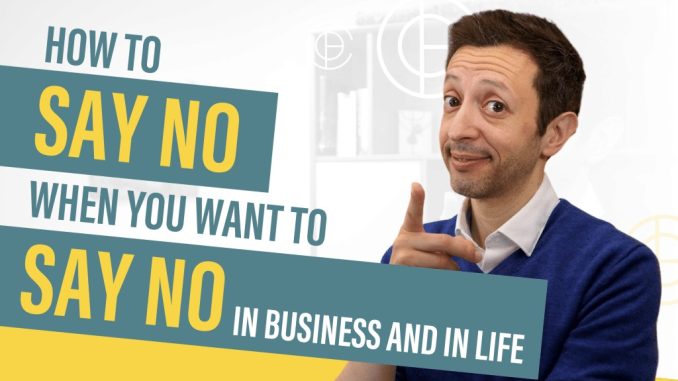
When to Say No in Business
In the fast-paced world of modern business, ambition is the air we breathe. We are driven by the pursuit of growth, the thrill of the chase, and the fear of missing out on the next big opportunity. This culture, especially in hyper-competitive hubs like Singapore, creates an immense pressure to be agreeable, available, and accommodating. The default answer to almost any request or opportunity becomes a reflexive “yes.” We say yes to new clients, additional features, and last-minute meetings, believing that each affirmation is a step forward. Yet, one of the most powerful and defining skills in a leader’s toolkit is the thoughtful, strategic, and courageous use of the word “no.” Far from being an act of negativity or limitation, saying no is the ultimate act of focus, protecting your most valuable and finite resources: your time, your energy, and your strategic direction.
The most common and seductive trap is the misaligned opportunity. This is the project or client that looks appealing on the surface—it may be profitable, prestigious, or simply available—but pulls the business away from its core mission. Chasing these tangential possibilities leads to strategic drift, where a company slowly loses sight of what it does best. Resources become thinly spread, the brand message gets diluted, and the team’s energy is diverted from its primary purpose. Consider a boutique marketing agency that excels at creating high-end, narrative-driven campaigns for luxury brands. If they say yes to a lucrative but rushed project for a mass-market discount retailer, they gain short-term revenue at a significant long-term cost. Their portfolio becomes confusing, their team’s specialized skills are misapplied, and they lose precious time that could have been spent cultivating their ideal clients. Saying no in this instance is not about rejecting revenue; it is about protecting brand integrity and committing to the long-term vision.
Equally important is the discipline to say no to unfavorable terms. Many entrepreneurs, particularly in the early stages, feel so grateful for a client’s interest that they accept deals that are fundamentally unsustainable. They agree to tight deadlines without sufficient resources, fixed prices for vaguely defined projects, or payment terms that strain their cash flow. This is a direct path to unprofitable work, team burnout, and client dissatisfaction. The failure to set firm boundaries from the outset inevitably leads to scope creep, where small additional requests accumulate until a project is no longer viable. The professional response is not necessarily an outright rejection. Instead, a strategic “no” can be a tool to open a negotiation. For example, when a client asks to add a new function to a software build, the answer can be, “That’s an excellent idea. We can certainly do that as part of a second phase, or we can revise our current timeline and budget to accommodate it. Let’s discuss what works best.” This reframes the conversation, protects the business’s health, and establishes a relationship built on mutual respect for resources.
Beyond the terms of a specific project, there comes a time to say no to entire client relationships. Not all revenue is good revenue. Some clients, despite paying their bills, consume a disproportionate amount of emotional and operational energy. They may disrespect boundaries with constant after-hours demands, exhibit poor communication, or foster a culture of blame that demoralizes your team. The hidden cost of these high-maintenance relationships is immense. They drain the morale of your best employees, monopolize your time, and prevent you from providing excellent service to your great clients. The decision to professionally disengage from such a client can be one of the most liberating and profitable choices a business can make. It frees up an incredible amount of capacity and creative energy, allowing you to reinvest in partnerships that are truly collaborative and rewarding.
Finally, the discipline of saying no must be applied internally with as much rigor as it is applied externally. The pressure to agree does not only come from clients. It comes from well-intentioned team members with new ideas, the perceived need to be in every meeting, and the desire to launch numerous initiatives simultaneously. A leader’s critical role is to serve as the strategic filter for the entire organization, protecting the team’s focus from a constant barrage of distractions. This often means saying no to good ideas in order to preserve the collective energy for the truly great ones. It is the practice of consciously deciding what not to do. By declining a meeting with no clear agenda or postponing a new project until the current priority is completed, a leader ensures that the team’s efforts are concentrated, effective, and aligned with the most important objectives.
In the final analysis, the art of saying no is the foundation of strategic execution. Every time you say no to a misaligned opportunity, an unfavorable term, or an internal distraction, you are implicitly saying a powerful yes to something more important. You are saying yes to your core mission, yes to the financial health of your business, yes to the well-being of your team, and yes to the clients who truly value your work. Success is not measured by the volume of activity, but by the impact of focused action. In a world that constantly demands more, the ultimate competitive advantage lies in the wisdom and courage to do what matters most, and that begins with knowing when to say no.