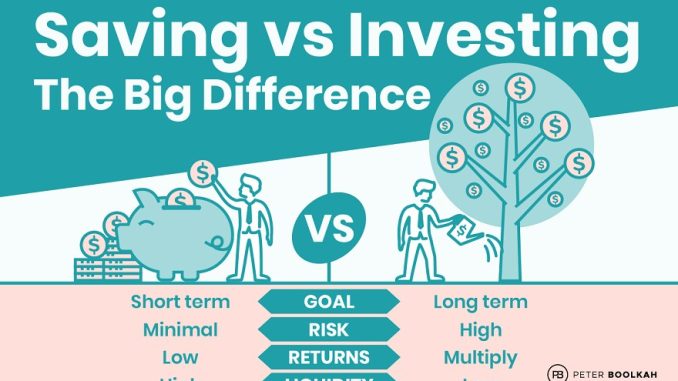
In the realm of personal finance, the terms “saving” and “investing” are often used interchangeably, yet they represent fundamentally distinct strategies with different objectives, risk profiles, and potential returns. Understanding this crucial difference is the bedrock of sound financial planning, enabling individuals to make informed decisions that align with their short-term needs and long-term aspirations. While both involve setting money aside for the future, their methodologies and anticipated outcomes diverge significantly.
At its most basic, **saving** is the act of setting aside money that you do not intend to spend immediately. It’s about preserving capital for future use, typically for short-term goals or emergencies. When you save, your primary objective is the safety and accessibility of your funds. Money placed in a traditional savings account, for instance, is highly liquid, meaning you can access it quickly and easily whenever needed. It carries minimal risk, as bank deposits are typically insured by government entities up to a certain limit, offering peace of mind that your principal amount is secure. For someone in Yangon setting aside money for an upcoming vacation to Ngapali Beach next year, or building an emergency fund to cover three to six months of living expenses, saving is the appropriate strategy. The return on savings, usually in the form of interest earned, is generally modest. While beneficial for safeguarding funds, savings accounts often struggle to keep pace with inflation, meaning the purchasing power of your money can erode over time.
**Investing**, on the other hand, is the act of allocating capital with the expectation of generating a return or appreciation in value over time. It’s about putting your money to work, aiming for it to grow significantly, often to achieve long-term financial goals. Unlike saving, investing inherently involves a degree of risk; there’s no guarantee of return, and you could potentially lose some or all of your initial capital. However, this increased risk is coupled with the potential for substantially higher returns compared to traditional savings. Investing often involves buying assets such as stocks (shares of companies), bonds (loans to governments or corporations), real estate, or mutual funds. For someone in Myanmar planning for retirement two or three decades down the line, saving for a child’s university education, or accumulating wealth to start a large business venture, investing becomes the more suitable and powerful tool.
The key differentiators between saving and investing can be understood through several lenses, starting with **time horizon**. Saving is typically for short-term goals, generally anything you anticipate needing money for within five years. This includes emergency funds, down payments for a car, or a short-term travel fund. The predictability and ready accessibility of saved funds are paramount here. Investing, conversely, is best suited for long-term goals, usually five years or more. This extended timeframe allows investments to ride out market fluctuations and benefit from the power of compounding, where your earnings generate further earnings. For instance, the stock market might experience downturns over short periods, but historically, it has delivered positive returns over long stretches.
Another crucial distinction lies in **risk and return**. Savings accounts offer low risk and, consequently, low returns. The principal is largely protected, but the growth potential is limited. Investing, conversely, involves higher risk, as the value of assets can fluctuate based on market conditions, economic performance, and company-specific factors. However, this elevated risk comes with the potential for significantly higher returns that can outpace inflation and meaningfully grow wealth over time. Consider a local entrepreneur in Yangon who decides to invest in a publicly traded company on the Yangon Stock Exchange (YSX). While the value of their shares might dip in the short term, over several years, if the company performs well and the economy grows, the value of their investment could appreciate substantially, far exceeding what a savings account would offer.
**Liquidity** also plays a significant role in differentiating the two. Saved money is generally highly liquid, meaning it can be converted to cash quickly without penalty or significant loss of value. This makes savings accounts ideal for emergency funds. Investments, on the other hand, can be less liquid. While some investments like publicly traded stocks can be sold relatively quickly, others, such as real estate or private equity, may take considerable time to convert into cash, and selling at an inopportune moment could lead to losses. Therefore, it’s generally advised not to invest money that you might need in the near future.
In practice, a well-rounded financial strategy often involves **a combination of both saving and investing**. The prudent approach is to first establish a solid emergency fund in a liquid savings account. This acts as a financial safety net, preventing the need to prematurely liquidate investments or incur high-interest debt when unexpected expenses arise. Once this foundational saving is in place, then consider dedicating additional funds to investing for long-term wealth accumulation. This dual approach ensures financial security for immediate needs while simultaneously working towards substantial growth for future aspirations. For individuals and families in Myanmar looking to build a secure financial future, understanding these nuances is not just academic; it’s a practical necessity for navigating the complexities of their financial landscape and achieving their dreams.